Thursday, 14 September 2017
Identification of individuals by trait prediction using whole-genome sequencing data
Today we are discussing the Identification of individuals by trait prediction using whole-genome sequencing data paper for Journal Club. As an extra set of content to examine, I've collected some of the articles and social media surrounding this paper:

Sunday, 22 January 2017
Journal Club + Shimmerlands ("Arrival") - 6pm on Wednesday 25/1/2017

To kick of Journal Club for 2017 we're taking advantage of the colocated Shimmerlands (http://www.shimmerlands.com/cinema/) on the Melbourne University campus for a combination journal club + movie night!
Alexis will lead us on "SiNVICT: ultra-sensitive detection of single nucleotide variants and indels in circulating tumour DNA" by Kockan et al.
We'll take advantage of the lawn and food/bar of the cinema and have an outdoor event from around 6pm in the Shimmerlands food/drink area.
After journal club there will be plenty of time to grab some dinner on campus:
We'll then see "Arrival". Everyone needs to buy their own tickets for the movie, and we'll try our best to sit together:
That's it! This will be a loosely organsied event, grab your own tickets for the movie and come for journal club, the movie or both!
Friday, 29 January 2016
Articles & Comics
tl;dr - Announcing:
- the publication of "Ten Simple Rules for a Bioinformatics Journal Club"
- the launch of the Journal Club Adventures comics
It is with some relief that the second article to come out of the Parkville Bioinformatics Journal Club has been published": "Ten Simple Rules for a Bioinformatics Journal Club".
Relief because we actually began this article almost two years ago in 2014! We had just studied the Ten Simple Rules collection as part of journal club, and thought it would be fun to write one ourselves.
During the early writing sessions for this idea, where we outlined things that we thought made the journal club a success, Harriet Dashnow made the offhand comment that it would be much easier to write Ten Simple Rules for Journal Club if there were a "Ten Simple Rules for Writing a PLOS Ten Simple Rules Article". That comment quickly escalated! (and distracted us for a few months).
Following the publication of that paper, and as the Journal Club continued to run in 2014, we returned to our first manuscript. Earlier versions of some of the rules were presented as a poster at the Australian Bioinformatics Conference (ABiC2014). It was at this point the conceit of including XKCD-style comics (thanks to the fantastic tool at http://cmx.io) was formed. We literally began by mocking up these comics on the backs of napkins (and HD may have adapted some XKCD comics in PowerPoint... because that's how science figures are done, right?).
 |
| Before http://CMX.io |
| After! |
We chipped away, and invited a few more authors to contribute to "Ten Simple Rules for a Bioinformatics Journal Club". Editing the text and going through several revisions (major and minor) took the better part of a year, mostly because this is a #sideproject, and contributions take place in the early mornings (during Writing Gym), late evenings and in the procrastination breaks that everyone has.
Note that even the most irreverent articles like these are peer reviewed, with the associated responses to comments, manuscript changes requested by editors and formatting requirements. As early-career researchers, it has been an invaluable experience.
One benefit of the long preparation was that as the journal club continued, we had more experiences to draw upon and the manuscript subsequently improved. It's been a fun experience, despite the long time from idea to publication. Thanks to all the other authors for their perseverance and hard work: Jocelyn, Michael and Tim.
Another silver lining is in that all that time, another idea has had time to develop and take shape in the background: Journal Club Adventures.
A few spurts of activity during that year of development, and time to think about how it could be done well using existing resources, resulted in a quick implementation that heavily leverages the original http://cmx.io. This design may change, but for a first attempt, it's functional and hopefully fun.
The origin of the comic itself is explained in adventure #0, and is setup to capture the same spirit of the Journal Club: a collaborative vehicle that we can use to show the lighter side of science and the community we've created that continues meets regularly at the uncivilised time of 8am.
Thanks for the ride!
Andrew and Harriet
@lonsbio @hdashnow
 |
| More comics will appear at Journal Club Adventures - https://journal-club-adventures.github.io |
Thursday, 26 March 2015
Glycoinformatics, I CHOose you!
Next meeting: Tuesday March 31st
This week at Journal Club we are going to branch* out into area of glycoinformatics (or glycobioinformatics) - that is the bioinformatics of carbohydrates (CHOs).
This week at Journal Club we are going to branch* out into area of glycoinformatics (or glycobioinformatics) - that is the bioinformatics of carbohydrates (CHOs).
 |
| Lactose is a carbohydrate. |
It's an area that is not commonly part of most introductions to bioinformatics, but exposure to them is literally in our blood*.
 |
| Blood type antigens |
The first paper provides some background and outlines the state and challenges of glycoinformatics, while the second deals with the online database for glycan structure, UniCarbKB.
Along the way, we'll touch on some database sustainability issues that have been addressed in UniCarbKB, and see what shape* the nomenclature for glycan structures is in.
The two papers are:
 |
| Consortium for Functional Glycomics (CFG) Nomenclature (http://www.functionalglycomics.org/) |
The two papers are:
I'm sure the discussion will be sweet*.
* All puns are intentional. I apologise for nothing.
Wednesday, 21 January 2015
Document Preparation and Its Discontents
To kick off 2015, the theme of yesterday's Journal Club was about increasing academic productivity. Two blog posts dealt with effective annual goal setting and "New Year's resolutions for scientists". Although interesting and full of useful ideas, these were rather uncontentious.
In contrast, some rather impassioned discussion was – perhaps predictably – inspired by an article in PLOS ONE with the understated title of An Efficiency Comparison of Document Preparation Systems Used in Academic Research and Development.
From the moment it was first published about a month ago, this article has been generating a lot of heated internet discussion. Both the comments section and the media coverage page reveal widespread indignation and scoffing. The authors have also made an extensive comment in which they answer some of the objections. (I'll keep referring to this as the response.)
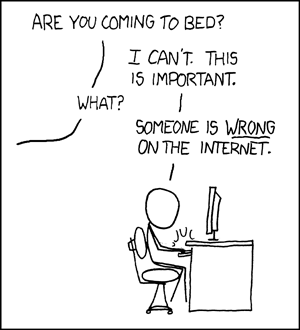
The discussion around our Journal Club breakfast table went on to mirror the same debate. Fortunately we're all friends so we managed to avoid taking it out onto the streets in full blown internecine warfare; although, it was close!
Concisely, Knauff & Nejasmic set up a study comparing LaTeX to Microsoft Word and their conclusion favours the latter for most tasks. The article has been criticised because of biases in the study design, and because its discussion takes results from this study and escalates to some strong assertions. Effectively, the authors proscribe the use of LaTeX except in certain circumstances; furthermore, they impugn the judgement of LaTeX users, not only in the article per se but again in their response to comments.
Since these criticisms can be found by going to the comments and media coverage sections linked above, there'll be little need to repeat them here. The intent here will be to focus on something that doesn't seem to have been targeted by many other comments or blog posts. This is, that the authors clearly feel entitled by their psychological training to make assumptions about their opponents' intellectual faculties. They do this without referring to any criteria of evidence. Their basis for measuring cognitive impairment is whether or not people agree with their conclusions.
Both article and response ring with cries of "cognitive dissonance"; and whereas the article attempts to justify its proscriptions by invoking "the taxpayer", that eternal hired thug of anti-intellectualism, the response more clearly reveals the authors' biases against LaTeX. The response is quite telling in the way the authors offer a blanket psychological assessment gratis to people who enjoy using LaTeX.
Namely, if you think it's important to keep content and structure separate to formatting instructions, then you are suffering under some colossal convergence not only of "cognitive dissonance" but now also "signalling" and "polarisation", with a bit of confirmation bias thrown in, oh my. This cutting analysis is mainly focused at LaTeX users, but they don't hesitate to advertise how they "think" that markdown "probably" shares many of the same problems.
Now, the authors belong to the Department of Psychology, Experimental Psychology and Cognitive Science at the University of Giessen. We can suppose, then, that they are psychologists. Maybe I'm suffering a bit of cognitive dissonance here, but I'm under the impression that psychologists would not consider themselves in a position to make sweeping statements about a diverse group of people without first conducting a study to investigate that group.
Note that this wouldn't be the same study as the one they've already undertaken, which was (ostensibly) concerned only with productivity differences between LaTeX and Word. In order to make broad assertions that LaTeX users suffer from cognitive dissonance and confirmation bias, reinforced by signalling and polarisation, then a study would need to be conducted on LaTeX users to see whether this characterisation has any basis in reality whatsoever.
Furthermore, by summoning forth all these psychological demons to support their overstretched assertions, do they not risk hoisting themselves by their own petards? For making guesses about other people's cognitive dissonances, confirmation biases, signalling and polarisation is a saloon door that can hit someone on the rear both while entering and leaving premises of ill repute.
After all, it's quite clear that Knauff & Nejasmic are indeed suffering, you guessed it, cognitive dissonance, confirmation bias, signalling and polarisation.
Cognitive dissonance: there is a disparity between the authors' scientific training and their jumping to conclusions based on biased study design. When this is brought to their attention, they attempt to reduce dissonance with unsatisfactory justifications (i.e. intensifying their poor arguments about LaTeX users' poor cognitive abilities), and by ignoring conflicting information ("Do we compare apples and oranges? We think that is just verbal hairsplitting ...").
Confirmation bias: this has been dealt with by those who have criticised the study's design, and the jump from the numerical results to wide-reaching conclusions. Furthermore, the response concludes with weasel words that strongly indicate their pre-existing bias: "in our group nobody uses LaTeX anymore since an efficient way of collaborating in the same document is more important to us than individual software preferences."
In other words, their group had already reached the conclusion that they don't like LaTeX. And if they began with a mixed group that became anti-LaTeX only after running the study, it seems unlikely that they would have failed to mention this. This implies that they had an anti-LaTeX group all along. So, the study concluding that LaTeX is usually inferior was designed and run by a group that had already decided without a study that LaTeX is inferior. Bias confirmed: check.
Signalling: if anything, this is the weakest argument against LaTeX. Humans signal all the time; it's part of being a social organism. If people in STEM didn't use LaTeX to signal, we'd still have the many other cool things which separates us from lesser mortals, such as version controlling everything and using the Unix command line for everything. I don't have a problem with the idea that LaTeX is a form of signalling because the signalling arises from its usefulness to a certain kind of person. My kind of person.
But if we want to use signalling as a basis for discrediting people, then it seems a little disingenuous of Knauff & Nejasmic to pretend that they're not also sending out signals. What better way to signal your cool contempt for a vast number of uptight math/computer nerds than publish an article calling for the banning of a beloved and venerable tool such as LaTeX? And should people on both sides of the debate stop publishing articles because this is a way to signal status in academia?
Polarisation: the thing with polarisation is that it needs two polar opposites to play off against each other. In psychology, polarisation is driven by a mechanism called the "pendulum effect". This requires two groups of people to make increasingly antagonistic statements towards each other. It doesn't work with just one group who have no one to argue against.
The only way polarisation could be responsible for generating a vocal LaTeX community is if LaTeX users have found themselves in arguments against people who are anti-LaTeX. That is, Knauff & Nejasmic, and their group, being anti-LaTeX, are in fact as much the victims of polarisation as their pro-LaTeX critics. What's more, if they take polarisation seriously, then it would behove them to take responsibility for driving the pendulum ever harder with their anti-LaTeX biases and extreme conclusions.
Overall, there is a twin problem with this psychological line of argument that Knauff & Nejasmic seem committed to. First of all, if the same argument can be used to win a debate in either direction, then you should probably be cautious about relying on it.
Secondly, and I think more importantly, it seems unethical for psychologists to carelessly diagnose all comers as having cognitive defects, with no burden of proof required, just for the purpose of point-scoring in an argument. I would hope at the very least that Knauff & Nejasmic will concede that this kind of behaviour has been inappropriate. They have an opportunity now to demonstrate their graciousness by apologising to LaTeX users for the numerous insults, and retracting their offensive and ill-conceived judgements.
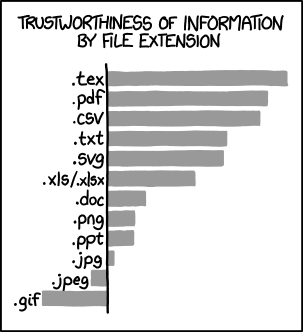
Well, since we seem to be operating in a post-scientific wasteland where unsupported assertions are fine so long as no taxpayers are having their minds stretched, it must be safe to conclude with this xkcd which was not created using any taxpayer money:
NB: if you found all this annoying and your primate brain chemicals are urging you to flame someone, you may cross swords with me on twitter.
Saturday, 11 October 2014
Ten Simple Rules for a Bioinformatics Journal Club
We are pleased to be presenting a poster based on our experiences creating and running this journal club at the first Australian Bioinformatics Conference:

Full size PDF (A0) available here
Friday, 7 March 2014
Publish and perish? Papers, blogs, criticism and the internet.
In recent meetings, journal club members have selected blog posts alongside traditional peer reviewed papers. These often complement the topics, and can offer practical, informal supplementary material to the published papers.

The contrast between them has led to some discussion on the place of blogs in science. Journal clubs members are adept at the technical platforms behind them; most of the journal club is organised through a complex combination of email, Facebook, mailing lists, Google Drive and determination. Many maintain their own blogs and have active social media presences, but there has been a sense of not wanting to waste material on a blog post. My personal opinion is that the more 'runs on the board', that is, the longer your lists of published papers record, the more likely you are to feel confident in blogging the work (or preview of the work) rather than publishing.

The differences between published papers and blog posts, criticism of each and the role the internet plays in all of this will be the topic this week. Note that the goal this week will not necessarily be to discuss the merits of all papers in depth. Rather, I'd like to discuss the issues raised by the following papers, blogs and social media commentary, and determine if it is possible to publish and perish, and if so, how to avoid it.

"Quilt plot"
Paper: "Quilt Plots: A Simple Tool for the Visualisation of Large Epidemiological Data"
Response: PLoS one comments and a blog post with commentary on the above and relevant links to other reactions.
Networks
Papers:
Network link prediction by global silencing of indirect correlations
Network deconvolution as a general method to distinguish direct dependencies in networks

Response:
http://liorpachter.wordpress.com/2014/02/10/the-network-nonsense-of-albert-laszlo-barabasi/
http://liorpachter.wordpress.com/2014/02/11/the-network-nonsense-of-manolis-kellis/
http://liorpachter.wordpress.com/2014/02/12/why-i-read-the-network-nonsense-papers/
http://liorpachter.wordpress.com/2014/02/18/number-deconvolution/

Rebuttal:
http://liorpachter.files.wordpress.com/2014/02/response_to_nonsense_blog_post.pdf
Subscribe to:
Posts (Atom)